|
|
|
|
|
|
|
|
|
|
Member: |

|
|
|
|
|
|
|
|
|
|
|
|
| "It is better to conquer yourself than to win a thousand battles. Then the victory is yours. It cannot be taken from you, not by angels or by demons, heaven or hell." Shakyamuni Buddha (563-483 B.C.) |
|
|
 |
|
 |
|
|
|
|
|
|
|
|
|
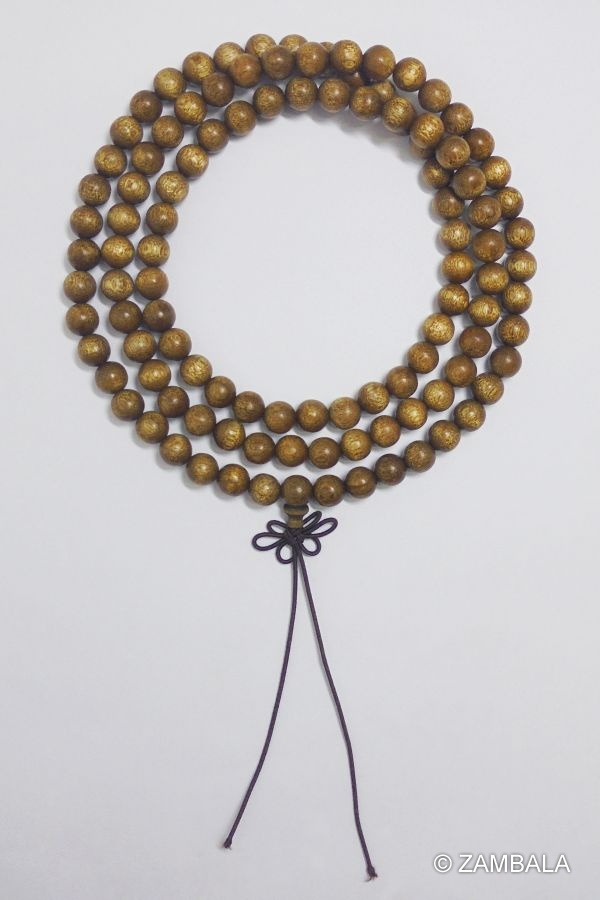
Malas - Tibetan Rosary >> Wood
|
|
|
 |
|
Please contact us to verify availability. 1-626-354-6228
Email: zambalallc@gmail.com
America area customers can view on this website first.
https://FlyingMystics.org/ |
|
|
|
|
|
|
Material: Phoebe zhennan wood.
Size: 8 mm, 108 beads
Description: Origin and Production of Phoebe zhennan Wood Prayer Beads
Phoebe zhennan wood (also known as Phoebe zhennan or Phoebe zhennan) is not a separate tree species, but a type of wood unique to China belonging to the Lauraceae family and the Phoebe genus (mainly Phoebe zhennan). Under specific growing conditions and at certain ages, a large number of crystals form in the wood grain, giving it a shimmering golden sheen and satin-like luster when exposed to sunlight, hence its name. It is mainly produced in Sichuan, Guizhou, Hubei, Yunnan, and other places, in shady and damp valleys or riverbanks at altitudes of 1000-1500 meters. It grows slowly, requiring hundreds of years to mature. Phoebe zhennan wood is resistant to decay and insects, not prone to warping or cracking, has a warm and smooth feel (warm in winter and cool in summer), and emits a light and elegant fragrance. Since ancient times, it has been known as the "wood of emperors," and during the Ming and Qing dynasties, it was exclusively used by the royal family (such as in palaces, dragon thrones, and coffins). Unauthorized use by commoners was even punishable by law. Currently a Class II protected plant in China, logging is prohibited. Most materials on the market are old wood from the Ming and Qing dynasties or submerged wood (a variant of ebony formed underground for thousands of years, with richer textures and a stronger aroma).
The process of making golden nanmu prayer beads:
- **Materials Selection**: Prioritize old wood or submerged golden nanmu. The texture should have obvious golden threads and water ripples (cloud patterns and landscape patterns are even more valuable), moderate density, and good oil content.
- **Craftsmanship**: Cut into round beads (common size 8-20mm), polished to a smooth and delicate finish (up to 2000 grit, like the touch of a baby's skin). No painting or waxing is required to retain the natural fragrance and luster. It is usually made with 108 main beads (standard prayer beads), plus a mother bead (Buddha head), spacer beads, and disciple beads, strung together. Submerged golden nanmu beads are often greenish-brown with a cat-eye-like crystalline surface.
- **Characteristics**: The finished product has a shimmering golden luster, a long-lasting fragrance, and easily develops a patina after handling (a warmer, more lustrous sheen).
Influence on Buddhism
Buddhist prayer beads (also known as rosaries or Buddhist beads) originated in ancient India. They were not unique to Buddhism but evolved from traditions such as Brahmanism, used to count recitations of mantras and prayers. Classical texts (such as the *Sapindus mukorossi Sutra*) describe how Shakyamuni Buddha taught the use of 108 beads strung together from Sapindus mukorossi seeds (soapberries), symbolizing the eradication of 108 afflictions and the attainment of 108 samadhis. Common materials include bodhi seeds, sandalwood, and crystal, with 108 beads being the most common (other types, such as 54 or 27 beads, have different symbolic meanings).
While golden nanmu wood prayer beads are not a traditionally specified material in Buddhist scriptures (early versions often used bodhi seeds or Sapindus mukorossi seeds), they are widely popular in Han Chinese Buddhism (especially in China), mainly because their characteristics align with Buddhist practice:
- **Calming and Soothing:** The delicate fragrance has the effect of dispelling dampness, invigorating the spleen, and opening the mind. Wearing or handling them helps with concentration, suppressing distracting thoughts, and even improving insomnia and nightmares (the fragrance suppresses nightmares). - **Protective and Amulet-Protecting Properties:** Its resistance to decay and insects, and its ability to endure for millennia, are considered highly spiritual, capable of warding off evil, attracting good fortune, and enhancing wisdom. It is suitable for use during Buddhist chanting and mantra recitation.
- **Cultural Integration:** Influenced by local traditions, Chinese Buddhism often uses precious woods such as Phoebe zhennan (golden nanmu) to create ritual implements or ornaments, symbolizing solemnity and merit. Many modern Buddhists (both monks and laypeople) enjoy using Phoebe zhennan prayer beads as bracelets or pendants, finding them both practical for counting and adding a sense of dignity and tranquility.
Overall, Phoebe zhennan prayer beads combine royal precious wood with Buddhist ritual implements, enhancing the calming and protective functions of the prayer beads. In contemporary times, they have become a popular choice for spiritual practice and wellness, reflecting the localized characteristics of Chinese Buddhism.

|
|
|
 |
|
|
|
|
|
© 2026 Zambala inc. All Rights Reserved. No part of this site may be reproduced without our written Permission.
Service Mail: ZambalaLLC@gmail.com
Phone: (626) 289-9787 or 1(888)Zambala (926-2252)
Fax: (626) 289-9719
1904 West Valley Blvd. Alahambra, CA 91803 USA
Unless stated otherwise in content's license. Design By
|
|
|