|
|
|
|
|
|
|
|
|
|
Member: |

|
|
|
|
|
|
|
|
|
|
|
|
| "All acts of living become bad by ten things, and by avoiding the ten things they become good. There are three evils of the body, four evils of the tongue, and three evils of the mind." Shakyamuni Buddha (563-483 B.C.) |
|
|
 |
|
 |
|
|
|
|
|
|
|
|
|
Malas - Tibetan Rosary >> Wood
|
|
|
 |
|
Please contact us to verify availability. 1-626-354-6228
Email: zambalallc@gmail.com
America area customers can view on this website first.
https://FlyingMystics.org/ |
|
|
|
|
|
|
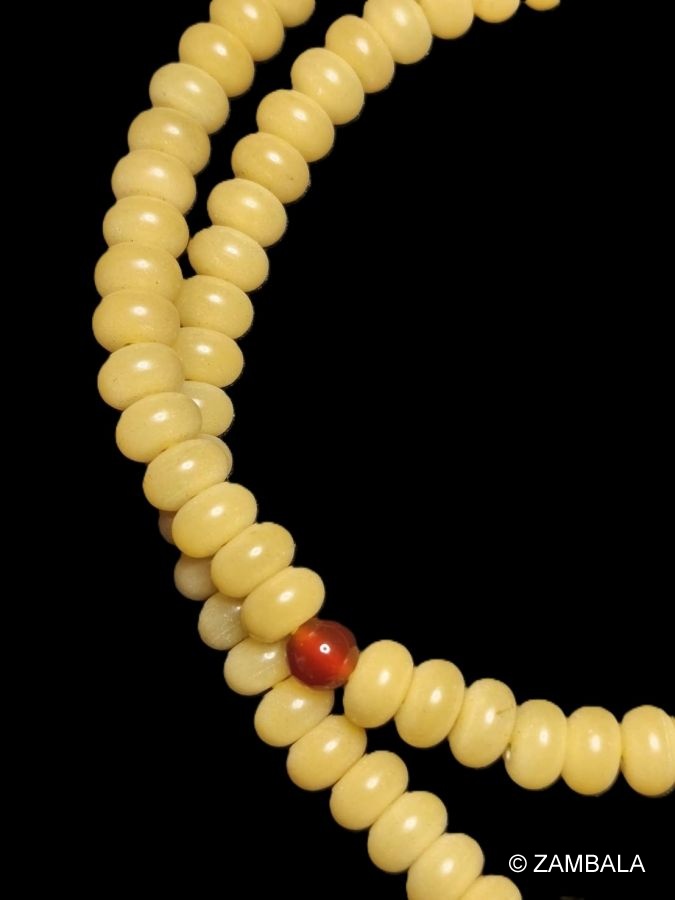
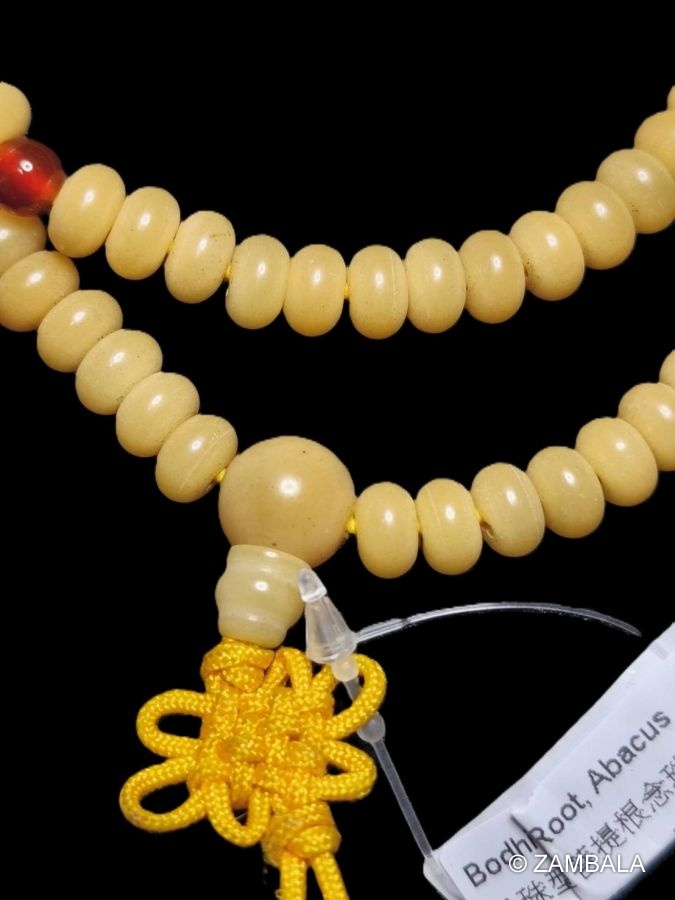
Material: Bodhi root, wood, seeds, rosary
Size: 8 x 4 mm / 108 beads + GB
Description: Origin of Bodhi Root Rosary
Bodhi root rosary (also known as Bodhi root bracelet, star and moon Bodhi root) is primarily made from the root (underground part) of the seed and fruit of a tree called "Small-leaved Purple Sandalwood Cherry" (scientific name: Elaeocarpus ganitrus var. sylvaticus, or a plant of the Dipterocarpaceae family in South India). This tree is considered a close relative or variant of the "Bodhi tree" in Buddhism because its fruit closely resembles the most famous "Bodhi seed" (the seed of the large-leaved fig, the fruit of the Bodhi tree on which the Buddha sat during his enlightenment).
- The most authentic and revered Bodhi root comes from the high-altitude region of the southern Himalayas, at an altitude of 1,500-2,500 meters, bordering Nepal, India, and Bhutan. Locals call it "Rudraksha" (Sanskrit for "Shiva's tears"). Hinduism considers it an incarnation of Shiva's tears, while Buddhism regards it as an extension of the Bodhi tree.
- Bodhi root prayer beads are a relatively new material that has gained popularity in Chinese Buddhism within the last 15-20 years. Early on (around 2000), they were mostly hand-dug from roots of trees over a hundred years old by local Nepalese. After years of handling and polishing, they turned ivory or off-white, with an extremely hard and fine texture, hence the name "Bodhi root."
- Later, due to the depletion of wild resources, over 90% of the roots on the market today are from artificially cultivated trees 20-30 years old, or are simply "root material" from the trunk near the root, resulting in a significant difference in quality.
Usage and Development Through Handling
The most crucial characteristic of Bodhi root prayer beads is that they become whiter and more translucent with handling, earning them the title of "plant prayer beads that can be played with to achieve an ivory-like texture." This is the main reason for their explosive popularity over the past decade.
Basic Usage
1. Common Sizes: 108 beads (authentic Buddhist prayer beads), 54 beads, 27 beads, 21 beads, 18 beads.
2. Initial State: Newly dug Bodhi roots are grayish-brown or yellowish-brown, with a rough surface and natural patterns and cracks.
3. Initial Handling:
- First Stage (0-3 months): Use clean hands to vigorously brush and rub the surface to remove dirt and oxidation. The color will gradually change from light brown to orange-red to orange-yellow.
- Second Stage (3-12 months): Continue handling. As the oils penetrate, a "glassy" or "crystal-like" finish will appear, and the color will turn milky white or off-white.
- Third Stage (1-3+ years): Top-grade Bodhi root beads will develop an "ivory-white patina," becoming as translucent as mutton fat jade, even exhibiting a semi-transparent "icy" effect. This is the "ultimate patina" most sought after by collectors.
4. Maintenance Method:
- Absolutely no oiling or applying walnut oil (oiling will actually cause it to darken).
- It relies solely on the body's natural oils and oxidation; it's purely "human-nurtured."
- You can use white cotton gloves to vigorously brush the beads to accelerate the coloring process.
Profound Impact on Buddhism (Especially Han Chinese Buddhism)
1. **Reawakening the Tradition of "Reciting Buddha's Name with Beads"**
- Over the past 20 years, many Han Chinese Buddhists (especially young people) believed that reciting Buddha's name only required verbal recitation, and that prayer beads were merely decorative. The playful nature of Bodhi root prayer beads, with their "changing with handling," has led many young people to pick up prayer beads again, handling them at least hundreds of times a day, unconsciously cultivating the habit of "reciting Buddha's name with beads." - In mainland China and Taiwan, it's now common to see young lay Buddhists chanting Buddha's name while handling Bodhi root beads at many Pure Land Buddhist centers, creating a new and vibrant scene.
2. **"Making Friends Through Beads": Building New Buddhist Communities**
- The collection and handling of Bodhi root beads has spawned numerous online and offline communities (WeChat groups, Douyin, Xiaohongshu). Many people have met fellow Buddhists through Bodhi root beads, leading them to engage with Buddhism, adopt vegetarianism, practice animal release, and even become monks.
- It can be said that Bodhi root beads are "one of the most successful mediums for propagating Buddhism" in contemporary Chinese Buddhism.
3. **Concretizing "Zen Joy"**
- The process of handling Bodhi root beads is itself a form of "Zen in motion," requiring patience, focus, and acceptance. Many players say, "When handling the beads, there are no distracting thoughts; it's easier to enter a meditative state than when sitting in meditation."
- When the beads transform from a rough, earthy yellow to a translucent ivory white, the sense of accomplishment—"the conditions are ripe, and the effort has not been in vain"—is remarkably similar to the joy of attaining enlightenment through spiritual practice.
4. **Controversy and Reflection**
- Some criticize Bodhi root prayer beads for being too expensive (top-grade old beads can easily cost hundreds of thousands of RMB) and for collectors' excessive attachment to appearances, contradicting the Buddha's teaching of "non-attachment."
- However, many eminent monks and virtuous masters hold positive views. For example, Master Jingkong and Master Shengxi have affirmed that "Bodhi root can help modern people concentrate on reciting the Buddha's name, and its merits are immeasurable."
In summary, although Bodhi root prayer beads are a "new material" that has emerged in the last twenty years, they have unexpectedly become one of the most important "supporting conditions" for contemporary Chinese Buddhism—using the most secular "pleasure of handling" to bring young people back to the most traditional "reciting the Buddha's name with prayer beads," making it a wonderful "skillful means" for 21st-century Buddhism in the Chinese-speaking world.
|
|
|
 |
|
|
|
|
|
© 2026 Zambala inc. All Rights Reserved. No part of this site may be reproduced without our written Permission.
Service Mail: ZambalaLLC@gmail.com
Phone: (626) 289-9787 or 1(888)Zambala (926-2252)
Fax: (626) 289-9719
1904 West Valley Blvd. Alahambra, CA 91803 USA
Unless stated otherwise in content's license. Design By
|
|
|